Commercial Flat Roof Replacement & Installation in Fort Pierce & The Treasure Coast
Low-slope and flat roofing covers the majority of commercial roof area on the Treasure Coast — warehouses, distribution centers, strip retail, office parks, manufacturing facilities. When a flat roof system fails or reaches end of life, it’s not a routine maintenance event. It’s a capital decision with performance, warranty, and operational consequences that play out over the next 20 to 30 years.
Rhino Roofs provides commercial flat roof replacement and installation across Fort Pierce, Port St. Lucie, Stuart, Vero Beach, West Palm Beach, and the surrounding Treasure Coast — working with facility managers, property owners, asset management groups, and general contractors on full system replacements, recover installations, and new construction flat roofing.
Commercial Flat Roof Installation — System Options & Engineering
TPO Single-Ply Membrane
TPO is the current standard for most commercial flat roof installations in Florida. White 60 to 80 mil TPO membrane reflects up to 85% of solar radiation, meaningfully reducing HVAC loads in occupied commercial buildings. Heat-welded seams — fused at over 800°F using robotic hot-air walk welders — create a monolithic, chemical bond across the full membrane field. There are no adhesive-dependent seams that degrade over time, and the attachment system is specified to ASCE 7-22 uplift requirements for your building’s exposure category.
TPO is appropriate for the large majority of commercial flat roof applications on the Treasure Coast — distribution facilities, big-box retail, office parks, and air-conditioned storage warehouses.
PVC Membrane for Chemical-Resistant Applications
PVC membrane carries the same heat-welded seam system as TPO with significantly higher resistance to chemicals, grease, oils, and animal fats — making it the specified membrane for restaurants, food processing facilities, and manufacturing plants where chemical exposure in the rooftop drainage stream disqualifies TPO. PVC is also highly fire-retardant, which matters for certain occupancy classifications.
Where chemical resistance isn’t a requirement, TPO is the more cost-efficient specification. Where it is, PVC is the right answer and we’ll say so directly.
Multi-Ply Modified Bitumen Systems
Modified bitumen provides a depth of waterproofing redundancy that single-ply systems don’t replicate — multiple reinforced layers creating a physically robust assembly that handles heavy foot traffic, frequent HVAC service access, and rooftop equipment impact without the vulnerability a single membrane layer carries. For commercial properties with high rooftop activity, multi-ply modified bitumen remains a well-proven Florida specification.
We install modified bitumen systems using torch-applied, cold-adhesive, or self-adhering methods depending on substrate conditions and project requirements.
Flat Roof Membrane Reference
TPO (White)
Thickness
60–80 mil
Primary Advantage
Solar reflectivity; heat-welded seam integrity; ASCE 7-22 compliant.
Best Application
Distribution, retail, office, warehouses
PVC
Thickness
60–80 mil
Primary Advantage
Chemical and grease resistance; fire-retardant
Best Application
Restaurants, food processing, manufacturing
Modified Bitumen
Thickness
Multi-ply
Primary Advantage
Maximum physical redundancy; foot traffic tolerance
Best Application
High-access rooftops with heavy HVAC service

Tapered Insulation — Engineering Positive Drainage
Ponding water — standing water that remains on a flat roof more than 48 hours after a rain event — is the most damaging chronic condition a commercial flat roof faces. It accelerates membrane degradation, adds structural dead load to the deck, and voids most manufacturer warranties. Florida Building Code requires positive drainage on low-slope commercial installations, and on many existing commercial properties, the original drainage configuration doesn’t meet that standard.
When drain positioning and surface slope are inadequate, we design and install tapered polyisocyanurate (polyiso) insulation board systems that create the required slope from the deck level — directing water to drains, scuppers, and internal collectors rather than allowing it to pond in low zones. Tapered insulation also improves the roof assembly’s thermal performance by increasing the effective R-value, which has a measurable effect on cooling costs in climate-controlled commercial buildings.
Crickets and saddles are integrated at HVAC equipment curbs and other projections that would otherwise create water collection zones regardless of field slope. Getting drainage right is an engineering task that happens at the insulation layer — not something that can be corrected at the membrane surface.
Florida Building Code & ASCE 7-22 Wind Engineering
Attachment Methods — Mechanical, Fully Adhered & Induction Welding
How a commercial flat roof membrane is attached to the substrate determines how it performs under the negative wind uplift pressures that coastal St. Lucie County generates during storm events. Three primary attachment methods are used depending on the substrate type, membrane system, and uplift calculation results for the specific building.
Mechanical attachment uses fasteners driven through the membrane and insulation into the structural deck at field and perimeter spacings calculated to the ASCE 7-22 uplift requirements for the building’s exposure category. Perimeter and corner zones require tighter fastener spacing than the field — because uplift forces concentrate there.
Fully adhered systems bond the membrane to the insulation board across the full surface area using adhesive — distributing uplift load more evenly than mechanical attachment and eliminating surface fastener points that can become stress concentrations under wind load.
Induction welding — sometimes called RhinoBond — bonds the membrane to the insulation board electromagnetically using metal plates embedded in the insulation. The system achieves high uplift resistance with fewer total fasteners, no membrane surface penetrations in the field, and excellent performance in high-wind coastal applications. For qualifying substrates, it’s an engineered solution worth evaluating on large commercial installations.
Parapet Wall Flashing & Termination Details
Parapet walls, roof edges, and all membrane termination points are where commercial flat roofs most commonly fail under wind load — and where inadequate detailing most consistently produces leaks. Termination bars, counter-flashings, and edge metal are installed to current Florida Building Code specifications at every perimeter condition, not approximated or simplified to reduce labor.
All penetration flashings at HVAC curbs, pipe penetrations, drains, and rooftop equipment are fabricated and installed to manufacturer specification. Flashing details that are right at installation don’t become leak sources in year three.
Our Commercial Flat Roof Replacement Process
A properly executed roof repair isn’t just replacing whatever broke. It’s understanding why it broke, assessing what else may have been affected, and fixing the system in a way that holds up to the next storm — not just the next few months.
Here’s how Rhino Roofs approaches every residential roof repair.
Step 1
Step 2
Step 3
Step 4
Step 5
Why Certified Commercial Flat Roof Installers Matter
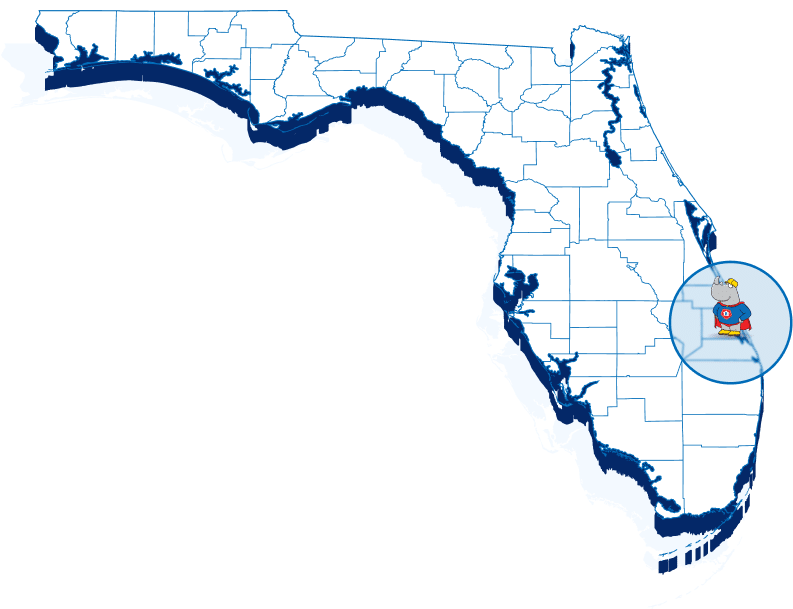
Commercial Flat Roof Service Areas — Fort Pierce & The Treasure Coast
Fort Pierce, FL
Our home base; TPO, PVC, and modified bitumen for all commercial property types
Port St. Lucie, FL
Commercial flat roof replacement for retail, office, and industrial
Stuart, FL
Flat roof installation and storm damage restoration
Vero Beach, FL
Low-slope commercial roofing for office, medical, and industrial
West Palm Beach, FL
Commercial flat roof replacement for Palm Beach County properties
Jensen Beach, FL
Coastal commercial flat roofing with ASCE 7-22 engineering
Palm City, FL
Commercial flat roof replacement and new construction
Hobe Sound, FL
Industrial and commercial low-slope roofing
Sebastian, FL
Full commercial flat roofing services
Hutchinson Island, FL
Coastal commercial flat roof installation
Hutchinson Island, FL
Large-scale warehouse and distribution flat roof replacement
A commercial flat roof replacement engineered correctly performs for decades.
One that isn't shows up within years.
Rhino Roofs is ready to assess your asset, develop the right system specification for your building and exposure, and install it to the standard that protects the investment.
Frequently Asked Questions About Residential Roof Repair on the Treasure Coast
What is ponding water and how does it affect a commercial flat roof replacement?
Ponding water is standing water that remains on a low-slope roof more than 48 hours after rain. It accelerates membrane degradation, adds dead load to the structural deck, and voids manufacturer warranties. A flat roof replacement that doesn’t address the drainage deficiency causing ponding will face the same problem on the new system. We treat drainage as an engineering problem solved at the insulation layer — not a surface repair.
What is an induction-welded flat roof system?
Can a new flat roof membrane be installed over an existing system in Florida?
What is an NDL warranty and why does it matter for commercial flat roofing?
An NDL — No Dollar Limit — warranty is issued by the membrane manufacturer and covers 100% of labor and material costs for covered failures without a financial cap. It requires installation by a certified contractor and passes a manufacturer field inspection at completion. For a commercial asset carrying a flat roof over 20 to 30 years, an NDL warranty is meaningful protection — and it requires an installation built to the standard that earns it.
TESTIMONIALS


