24/7 Emergency Commercial Roof Repair in Fort Pierce & The Treasure Coast

When a storm compromises a commercial roof, rapid response limits damage before permanent repairs are possible. Water entering through a torn membrane can quickly damage insulation, decking, and interior assemblies, leading to inventory loss, tenant displacement, and larger insurance claims.

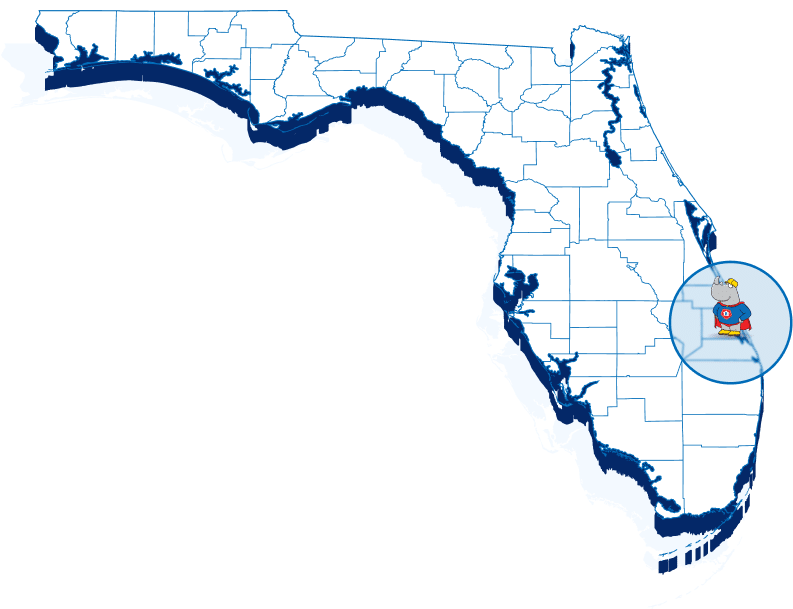
Rhino Roofs provides 24/7 emergency commercial roof repair and storm damage response across Fort Pierce, Port St. Lucie, Stuart, Vero Beach, West Palm Beach, and the surrounding Treasure Coast. We stabilize the building envelope, document damage, and complete permanent code-compliant repairs as quickly as conditions and permitting allow, following commercial safety, insurance, and operational requirements.

Rapid Commercial Storm Damage Response to Protect Your Operations

The priority in the hours following a storm is stabilization, not repair. Getting the building envelope secured against continued water intrusion — while damage is assessed and a permanent scope is developed — is what separates a contained restoration event from a cascading loss that reaches structure, mechanical systems, and tenants.

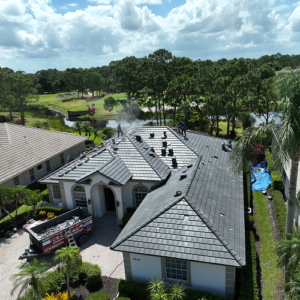
Our emergency teams coordinate directly with facilities management on arrival, establish OSHA-compliant safety perimeters to protect occupants and pedestrians, and immediately deploy commercial-grade tarps and, where structural damage warrants it, heat-shrunk membrane systems that provide a tighter weather seal over large exposed areas than standard tarping allows.

The right stabilization approach depends on what’s beneath the roof and what continued exposure costs the business. We assess occupancy conditions, contents at risk, and operational priorities before determining the mitigation method — not after.

Emergency Commercial Roofing Repair for All System Types

Roof leaks rarely look the same twice — and the right repair depends entirely on the material system, the failure point, and what’s happening beneath the visible surface. Rhino Roofs diagnoses and repairs all three primary residential roofing systems found across the Treasure Coast.

Flat Roof & Single-Ply Membrane Stabilization — TPO, PVC & EPDM

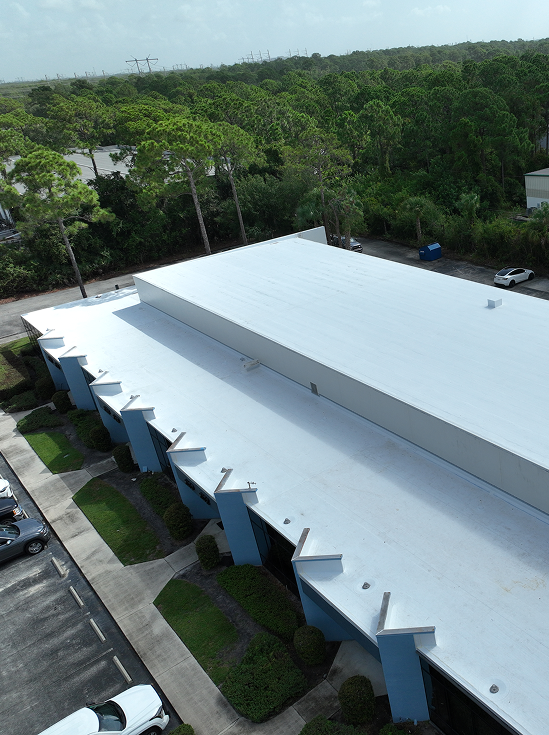
Low-slope membrane systems are common on commercial roofs across the Treasure Coast. Hurricane-force winds concentrate uplift forces at perimeter zones, seams, and areas with insufficient fastening. When edge flashings fail or seams separate, membrane sections can displace, exposing insulation and structural decking to rain. Emergency response begins with perimeter sealing and temporary membrane reinforcement. All damage is photographed before stabilization to preserve an accurate insurance record. Permanent seam repairs use hot-air welding with virgin membrane material, while penetration and parapet flashings are rebuilt rather than sealed over.

Modified Bitumen & Built-Up Roofing Storm Repair

Multi-ply systems are less prone to catastrophic membrane displacement, but storm events frequently cause edge and parapet flashing failures and surface damage at zones where the membrane was already near end-of-life. Sub-surface moisture accumulation — from water that infiltrated before or during the event — is often not visible from above. We conduct infrared thermal imaging as part of every multi-ply storm assessment to map hidden saturation and scope permanent repairs to address both the surface damage and the substrate beneath it.

Commercial Metal Roof Storm Repair

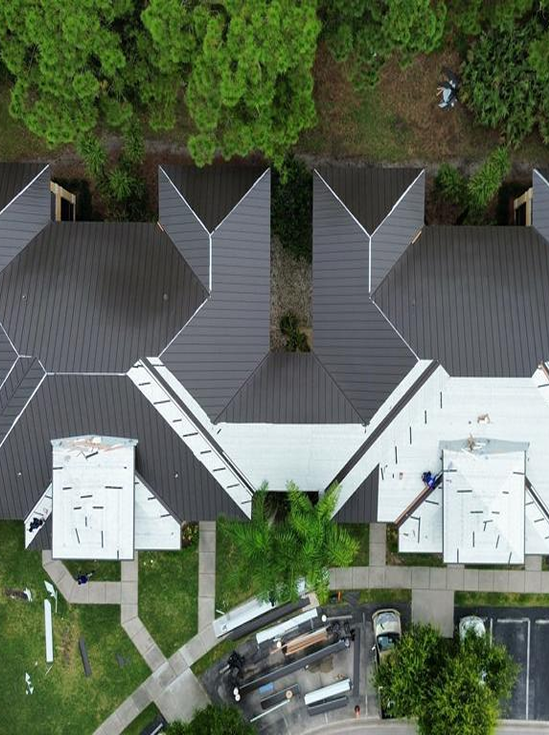
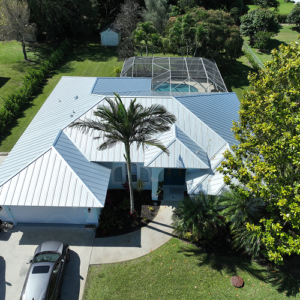
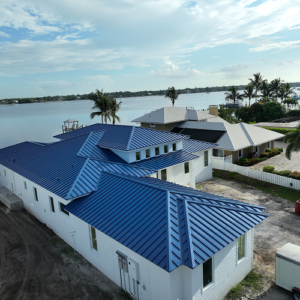
Storm damage on commercial metal roofs concentrates at ridge caps, perimeter flashings, HVAC curb flashings, and fastener points on exposed-fastener systems. Ridge cap displacement and perimeter flashing tear-off allow wind-driven water into the wall assembly; fastener pullback creates a cascading leak risk across the affected panel field. Emergency response includes custom fabrication of temporary cap and flashing sections in matching gauge material, fastener replacement, and debris puncture repair. Permanent repairs follow the same custom fabrication approach — matching your existing panel profile rather than substituting incompatible materials.

Commercial Storm Vulnerability Reference

Low-Slope TPO / PVC / EPDM

Primary Storm Failure Mode

Wind uplift at perimeters and seams; debris punctures; flashing displacement

Emergency Response

Commercial tarping or shrink-wrap; hot-air weld seam repair; full damage documentation

Primary Storm Failure Mode

Edge and parapet flashing failures; sub-surface moisture

Emergency Response

Thermal imaging moisture mapping; ply-level assessment; staged permanent repair

Primary Storm Failure Mode

Ridge cap displacement; perimeter flashing tear-off; fastener pullback

Emergency Response

Gauge-matched temporary fabrication; fastener replacement; curb flashing restoration

Storm Damage Documentation & Commercial Insurance Support

Commercial property insurance claims require documentation that meets a higher standard than residential claims. Adjuster reviews and board-level approvals move on the strength of what’s submitted — and gaps in the damage record create delays and disputes.

Systematic photography

Every affected zone is documented before any stabilization material is applied, organized by roof zone and mapped to the building layout.

Our damage assessments produce line-item written scopes formatted to align with what commercial property insurance adjusters work with — reducing back-and-forth on scope interpretation.
We document what the storm caused. We don’t inflate assessments or obscure pre-existing conditions. An accurate, well-supported claim processes more reliably than an inflated one — and protects the property owner from disputes and misrepresentation findings.
Report damage to your broker immediately following the event — before permanent repair work is underway. We coordinate with your adjuster and any public adjuster your organization engages throughout the process.

Our Commercial Emergency Response Process

Step 1

Dispatch & Safety Staging. We coordinate with your facilities team, establish OSHA-compliant fall protection and safety perimeters, and confirm occupant protection before anyone accesses the roof.

Step 2

Stabilization & Weatherproofing. Commercial-grade tarps or shrink-wrap systems are deployed to stop active water intrusion. All stabilization is documented photographically before and after materials are placed.

Step 3

Damage Assessment & Moisture Mapping. Once conditions allow full-roof access, we inspect the entire system and deploy infrared thermal imaging on flat roof systems to map subsurface moisture without destructive investigation.

Step 4

Insurance-Ready Written Estimate. A line-item damage report and repair scope is provided, formatted to the documentation standards commercial insurance adjusters require.

Step 5

Permitted Permanent Repair. We apply for St. Lucie County emergency permits — typically expedited for storm damage — and execute permanent repairs to current Florida Building Code wind uplift standards using Florida Product Approval certified materials.

Emergency Commercial Roofing Service Areas — Fort Pierce & The Treasure Coast

Fort Pierce, FL

Our home base; 24/7 emergency dispatch for all commercial system types

Port St. Lucie, FL

Commercial storm response for retail, office, industrial, and multi-family

Stuart, FL

Emergency commercial roof stabilization and storm damage assessment

Vero Beach, FL

Commercial storm damage repair for all property categories

West Palm Beach, FL

Emergency commercial roofing for Palm Beach County properties

Jensen Beach, FL

Coastal commercial emergency response

Palm City, FL

Commercial storm damage response and emergency repair

Hobe Sound, FL

24/7 commercial emergency dispatch and storm assessment

Sebastian, FL

Full emergency commercial roofing services

Hutchinson Island, FL

Coastal commercial and hospitality property storm response

For multi-property portfolios affected by a single storm event, call us directly — we coordinate multi-site dispatch and prioritize by damage severity and operational impact.

When a storm hits your commercial property, the response matters as much as the repair.

We’ll stabilize your building, document what happened accurately, and give you a clear written scope for permanent repair — without inflated findings or pressure to approve more than the damage warrants.

Frequently Asked Questions About Commercial Storm Damage Repair

What should an asset manager do immediately after storm damage to a commercial roof?

Clear affected interior areas, document interior leak locations with photos, and call a licensed commercial emergency roofing contractor to dispatch a stabilization crew. Simultaneously, notify your insurance broker to open a claim log — the date and time of first notice matters. Both calls can be made before the storm has fully cleared.

Yes, in most cases. Commercial property policies require policyholders to take reasonable steps to prevent secondary damage following a covered loss. Emergency tarping and shrink-wrap are classified as mitigation expenses and are typically reimbursable as part of the storm damage claim. We document all mitigation work so the expense is clearly supported in your submission.

Hurricane-force winds create aerodynamic negative pressure — suction — across flat roof surfaces. That force concentrates at perimeters, corners, and seam zones. When edge flashings fail or fastening density is below the calculated wind load, membrane sections can peel back rapidly from the perimeter inward, exposing insulation board and structural decking to direct wind-driven rainfall.Yes, in most cases. Commercial property policies require policyholders to take reasonable steps to prevent secondary damage following a covered loss. Emergency tarping and shrink-wrap are classified as mitigation expenses and are typically reimbursable as part of the storm damage claim. We document all mitigation work so the expense is clearly supported in your submission.
We dispatch as soon as it is safe for crews to access rooftops — typically within one to two hours of storm clearance. During widespread events affecting multiple properties, response time may vary. Calling the emergency line directly gives you the most accurate current dispatch availability.

TESTIMONIALS

Antonio Vargas
Antonio Vargas
I just had my roof replaced from Rhino roofing. My home is on Avenel lane in the PGA Village. I’m very satisfied on their promptness and quality of work. Ronnie, the project manager, was with me every step of the way. He made the experience worry free! Let’s face it.. it’s a huge investment.. and him picking up the phone and answering my questions Was wonderful.
Adjua Satchell
Adjua Satchell
had a wonderful experience with the company, no surprises. Carl, the sales rep is professional, on time and answered all my questions even after hours. I would definitely recommend Rhino Roofs. But most if all my roof looks beautiful.
Satie Rattan
Satie Rattan
My experience with Rhino Roofs was very good, my sales person was Phil who is very knowledgeable,and answered all my questions. I would recommend this company to anyone.
Robin
Robin
Ronnie was absolutely amazing from start to finish. Whenever I had a question he had the answer. Always answered text messages or calls within minutes of me contacting him. There were a few discrepancies with the project and he handled immediately. I definitely would recommend Rhino Roof for your project💕💣
Michey H
Michey H
Recently had the pleasure of working with Rhino, and I cannot recommend them enough! They were incredibly helpful, professional, and kind from the first call. Their team went above and beyond to answer all of my questions and make sure I understood the entire process, which made me feel confident and informed every step of the way. If you're looking for a roofing company that is reliable, hardworking, and genuinely nice to work with, look no further. I will definitely be recommending them to friends and family!